

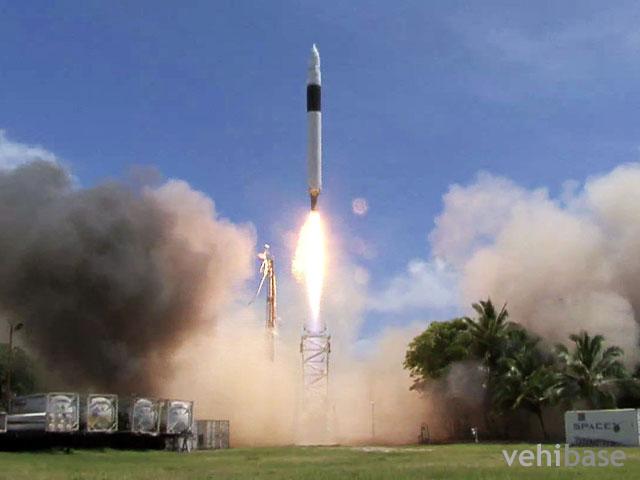
The SpaceX Falcon 1 was the first orbital launch vehicle developed and produced by SpaceX, the aerospace company founded by Elon Musk. It was a small, partially reusable rocket designed to carry small payloads to orbit. The Falcon 1 played a crucial role in SpaceX's early years and was a stepping stone toward the development of larger rockets like the Falcon 9 and Falcon Heavy.
The Falcon 1's development and initial flights were significant milestones in the commercial space launch industry, showcasing SpaceX's ambition to reduce the cost of space access through reusability and innovative technology.
Key Features
Pros
Cons
Frequently Asked Questions
How many Falcon 1 rockets were launched?
A total of five Falcon 1 rockets were launched between 2006 and 2009.
What were some of the payloads carried by the Falcon 1?
The Falcon 1 launched payloads for various customers, including scientific experiments and small satellites.
Did the Falcon 1 achieve reusability like the later SpaceX rockets?
While the Falcon 1 featured some reusability elements, it did not achieve the same level of reusability as later SpaceX rockets like the Falcon 9. SpaceX's focus on reusability was further developed in subsequent rocket designs.
Why was production of the Falcon 1 discontinued?
Production of the Falcon 1 was discontinued after a few launches due to its relatively limited payload capacity and the company's shift toward larger, more capable rockets like the Falcon 9.
2 members saved it

Related spacecrafts


Did you know?
The fourth flight of the Falcon 1, in September 2008, marked a significant milestone as it became the first privately developed liquid-fueled rocket to reach orbit.
The success of the Falcon 1 played a pivotal role in securing contracts and investments that enabled SpaceX to continue its ambitious goals in space exploration, including crewed missions to the International Space Station (ISS).
