

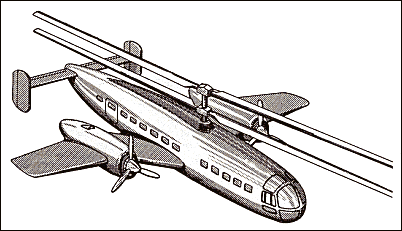
Gyrodyne Gyroliner
The Gyrodyne Gyroliner is a historic American experimental helicopter developed by the Gyrodyne Company of America in the mid-20th century. It was designed as a tiltrotor aircraft, featuring both helicopter and airplane capabilities. The Gyrodyne Gyroliner aimed to combine the vertical takeoff and landing (VTOL) capabilities of a helicopter with the speed and range of a fixed-wing aircraft.
The Gyrodyne Gyroliner was an innovative project that contributed to the development of tiltrotor technology. While it did not enter full-scale production, it served as an important testbed for exploring the possibilities of tiltrotor aircraft, which later became a reality with aircraft like the Bell XV-15 and the V-22 Osprey.
Key Features
Pros
Cons
Frequently Asked Questions
What was the primary purpose of the Gyrodyne Gyroliner?
The Gyrodyne Gyroliner was primarily designed as an experimental tiltrotor aircraft to explore the combination of helicopter and airplane capabilities, achieving vertical takeoff and landing (VTOL) and fixed-wing flight.
How did the Gyrodyne Gyroliner contribute to aviation technology?
The Gyrodyne Gyroliner served as a pioneering project that contributed to the development of tiltrotor technology, laying the groundwork for future tiltrotor aircraft like the Bell XV-15 and the V-22 Osprey.
Did the Gyrodyne Gyroliner enter full-scale production or operational service?
No, the Gyrodyne Gyroliner did not enter full-scale production or operational service; it remained an experimental aircraft.
What impact did the Gyrodyne Gyroliner have on aviation history?
The Gyrodyne Gyroliner played a significant role in advancing tiltrotor technology, which has since been applied in various aircraft, particularly in the military sector, for its versatile VTOL and fixed-wing capabilities.
4 members saved it




Did you know?
The Gyrodyne Gyroliner was an early exploration of tiltrotor technology, showcasing the potential to combine the advantages of helicopters and fixed-wing aircraft in a single platform.
Although it did not achieve widespread operational use, its contributions to aviation research paved the way for the development of tiltrotor aircraft that are now in active service.
