

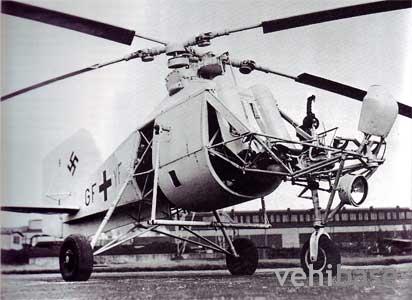
The Flettner Fl 282 Kolibri is a historic German helicopter developed during World War II by Anton Flettner's company, the Flugzeugbau Friedrichshafen. It is recognized as one of the world's first production helicopters. The Fl 282 featured an intermeshing rotor system, where two rotors rotated in opposite directions without a tail rotor, giving it a distinctive appearance and remarkable stability.
The Flettner Fl 282 Kolibri played a significant role in the development of early helicopter technology and served various roles during the war, including reconnaissance and liaison missions. Its innovative design and compact size allowed it to operate from small ships and confined spaces.
Key Features
Pros
Cons
Frequently Asked Questions
What is the historical significance of the Flettner Fl 282 Kolibri?
The Flettner Fl 282 Kolibri is historically significant as one of the world's first production helicopters and for its innovative intermeshing rotor system.
How did the Kolibri achieve stability without a tail rotor?
The Kolibri achieved stability through its intermeshing rotor system, where two rotors rotated in opposite directions, canceling out the need for a tail rotor.
What roles did the Kolibri serve during World War II?
The Kolibri served various roles, including reconnaissance and liaison missions, and its compact size allowed it to operate effectively from small ships.
Is the Kolibri still in operation today?
No, the Flettner Fl 282 Kolibri is a historic helicopter, and no operational examples are known to exist today.
4 members saved it

Related helicopters

Fairchild Hiller FH-1100
(3) 6

Fairchild Hiller HJ-1 Hornet
(1) 3

Fairchild Hiller HOE-1 Hornet
(5) 9

Fairchild Hiller O/UH-23 Raven
(3) 6
Fairchild Hiller Ten99
(2) 6

Fairchild Hiller UH-12
(3) 5
Fairchild Hiller VZ-1 Pawnee
(3) 6

Fairchild Hiller X-18
(5) 7

Fairchild Hiller X-2-235
(5) 5
Fairchild Hiller XH-44
(2) 6

Fairey Gyrodyne
(3) 5
Fairey Jet Gyrodyne
(1) 1
Did you know?
The Flettner Fl 282 Kolibri's intermeshing rotor system was a remarkable engineering innovation of its time, providing stability and maneuverability without the need for a tail rotor.
Its compact size and ship-based operations demonstrated the helicopter's versatility in confined spaces and contributed to the development of rotorcraft for naval use.
